The Giants Don't Die. They Just Get Outgrown.
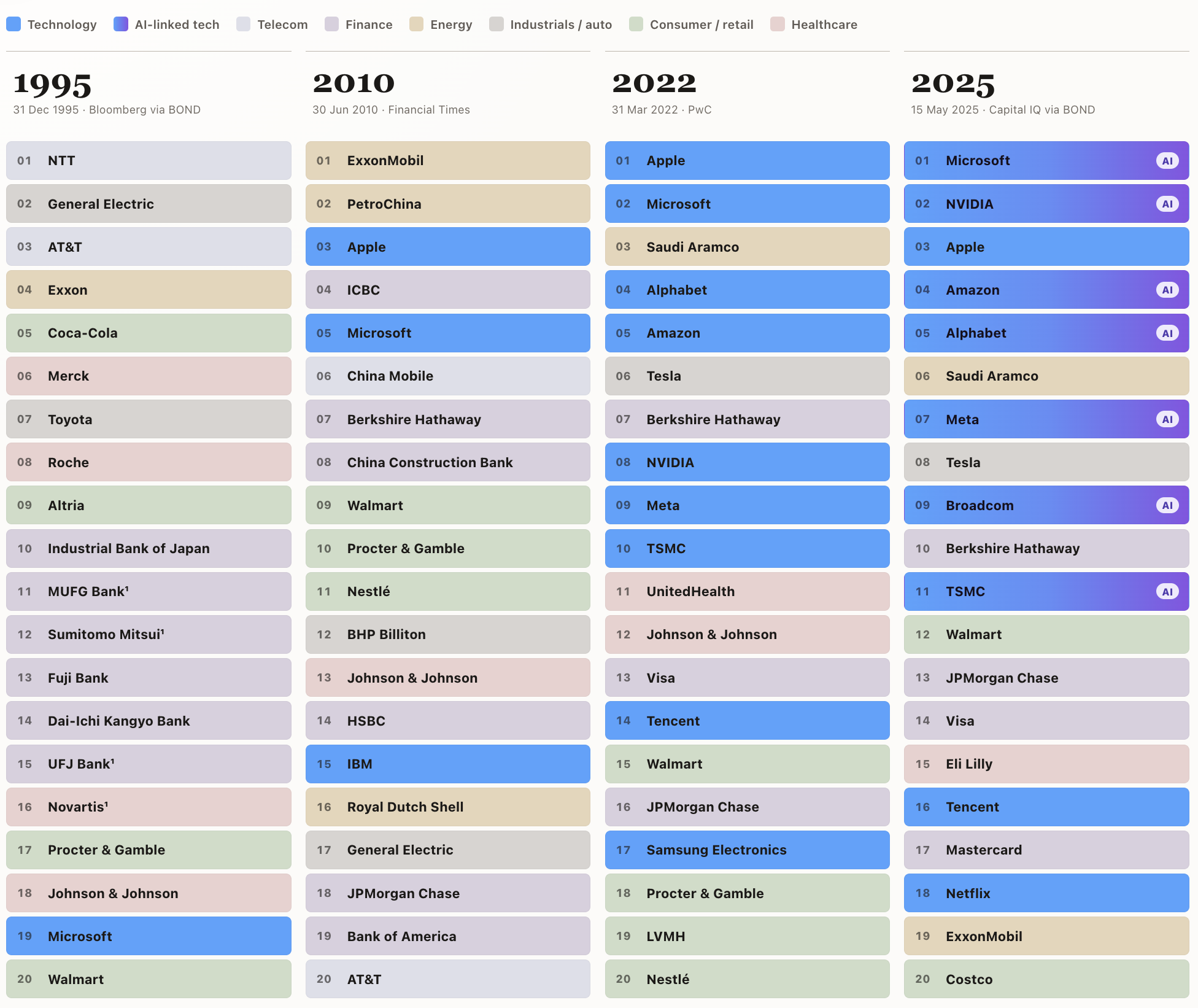
Let’s look at the world’s most valuable companies in 1995, at the dawn of the web. The biggest was a Japanese telephone company. General Electric came second, AT&T third, followed by Exxon and Coca-Cola. Japanese banks occupied six of the top twenty places. It was a fine time to own telephone lines, oilfields, or a very large balance sheet.
Microsoft just scraped into the top twenty. Google didn’t exist. Jeff Bezos was selling his first few books from a new website. Nvidia was a startup.
Flash forward thirty years. Microsoft, Nvidia, Apple, Amazon and Alphabet occupy the first five places. Of the thirty most valuable companies in 1995, just six are still in the top thirty.
Although that sounds like a corporate massacre, the facts are more interesting.
The losers kept growing
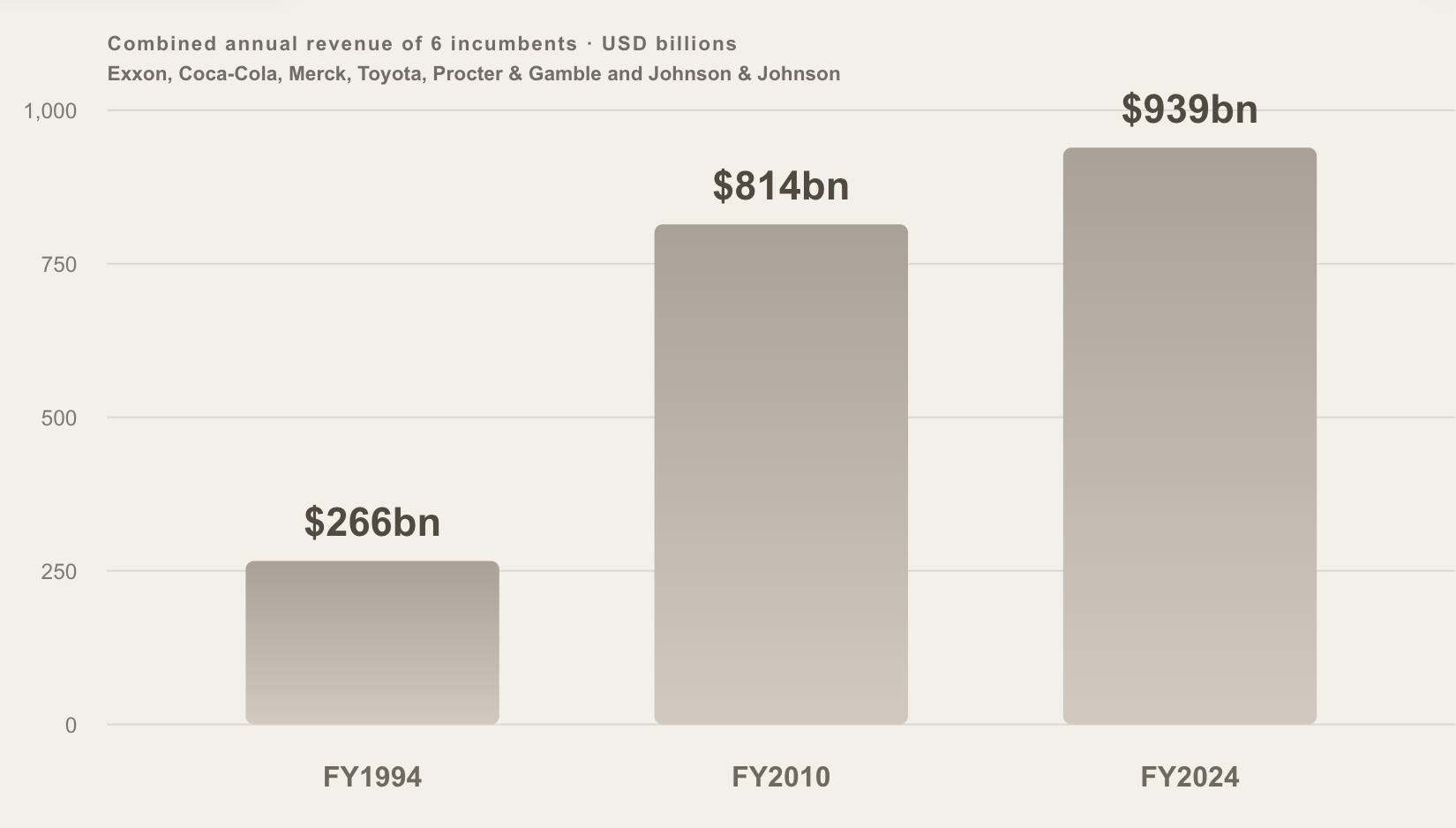
Let’s take a closer look at six familiar incumbents from the 1995 list: Exxon, Coca-Cola, Merck, Toyota, Procter & Gamble and Johnson & Johnson. Between fiscal 1994 and fiscal 2024, their combined annual revenue grew from roughly $266 billion to $939 billion. That’s 3.5 times as much in nominal dollars, and substantial growth even after inflation.
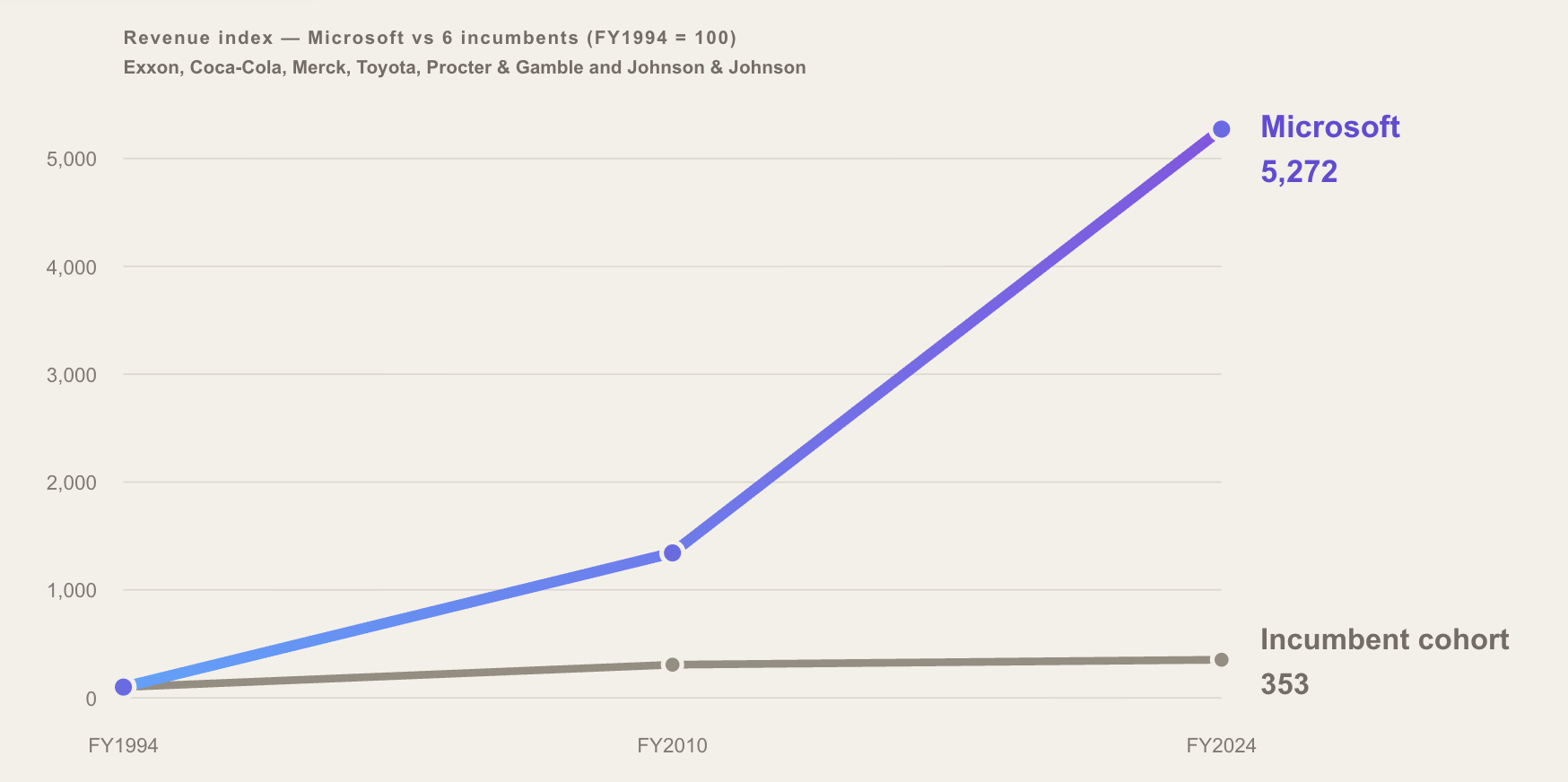
Microsoft, however, went from $4.65 billion to $245 billion. More than fiftyfold nominal growth.
These aren’t perfectly clean comparisons (given mergers, acquisitions and reporting changes), but the gap between the traditional and the digital native is more than clear.
The incumbents actually benefited from the technologies that were supposed to be disrupting them. Better logistics, cheaper computing, faster communication, more efficient suppliers, new customers. An oil company could use better software without becoming a software company. A carmaker could run a more efficient supply chain. And a wealthier world could buy more cars, soft drinks and pharmaceuticals.
This helps explain the blasé attitude of many executives when they are told they’ll be disrupted by AI. After thirty years of dire warnings that Silicon Valley was coming to eat their lunch, many CEOs discovered that dinner was being served. Their businesses were bigger than ever. Learning not to listen too closely to Silicon Valley was a perfectly reasonable response.
But some did not make it
The usual list: Blockbuster, Kodak’s film business, newspaper classifieds. They didn’t miss the memo about the internet, they just got replaced by it.
Streaming replaced the trip to the video shop. Digital photography eliminated the need for film. Craiglist etc replaced newspapers’ privileged position connecting buyers and sellers.
The critical distinction was substitution. The internet made some businesses more productive, but it made others unnecessary. What will AI substitute for over the next decade?
The last mile of automation
For decades, digitisation and the Web have been automating business. Information became digital, transactions moved online, systems became connected, and customers could be reached almost anywhere.
But much of the work inside companies still required people to interpret information, exercise judgement, solve problems and make decisions. Software helped them do it faster.
AI may now automate the last human-dependent steps in entire businesses. Completing that last mile could catalyze something more dramatic than the preceding decades of automation.
Consider a travel insurance claim for lost luggage. The customer submits a claim with a booking confirmation and receipts. Someone checks the policy, someone verifies the loss and the costs, someone looks for fraud, and someone authorises payment. The checks may each take minutes. The claim can still take days as it waits in one queue after another.
Lean management uses value stream mapping to follow work through the company and measure how long it spends being worked on versus waiting. Too often, most of the time is spent on nothing, so speeding people up with AI can only yield a marginal improvement at best.
The company you wouldn’t build
Traditional organisations are shaped around human specialisation. People have different skills, so companies have departments. Work passes between them, with managers and systems to keep it moving. Bureaucracy has always been the price of scale.
But imagine starting the same business today, with AI. Would you organise it around those departments? If you physically need people to do the work (hospitals, restaurants, childcare), much of that structure still makes sense. But if your people are knowledge workers, probably not.
Can we get there from here?
There’s an old joke about a driver who gets lost in Kerry and stops to ask for directions. The local replies: “Well, if I were you, I wouldn’t start from here.”
An established company has no choice but to start from here. Its customers, brand, expertise, data and trust took decades to build. It can’t throw those away to copy a startup. But the organisational architecture that implements those advantages are blocking a new way of working.
So ask: If we were starting from scratch today, how would we build a company designed to put us out of business?
Then find a way to build it first.