
Software products are collapsing into AI agents, and professional services are collapsing into AI agents too. A lot of people have noticed one of these disruptions, but few have figured out what the combined effect is, or what kind of company will survive it. It's a new kind of company, and it's all that's going to be left after AI disruption has ripped through our industry.
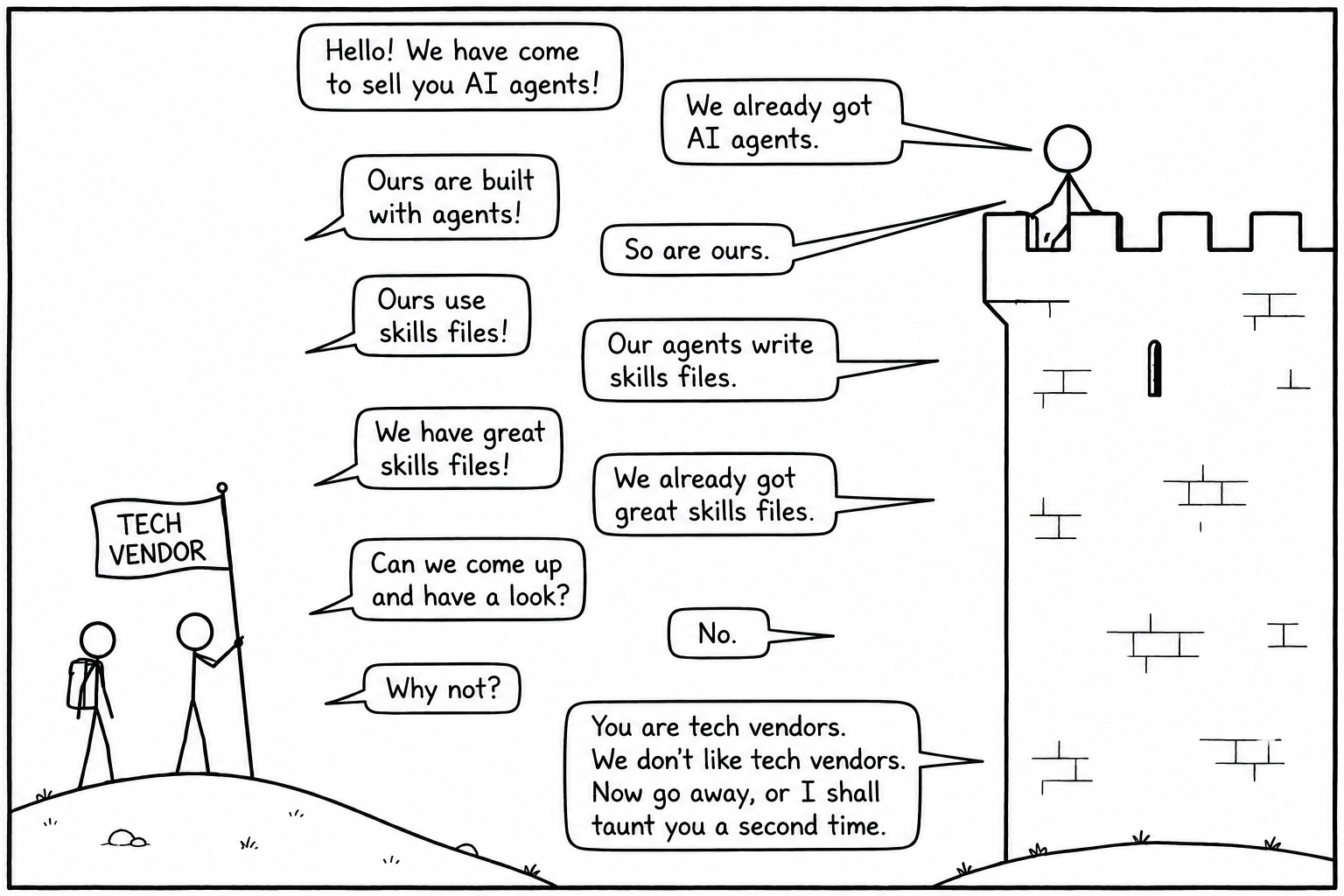
Products are collapsing into agents
This isn't just about the cambrian explosion of software that's happening right now due to widespread use of AI coding agents.
The person who used to buy your software product has an AI assistant now (or soon will). They don't need to go looking for products anymore. When they have a job to be done, they describe it to their agent, and it gets done. Maybe entirely in LLM context. Maybe it builds a repeatable skill. Maybe it converts the skill to Python or Rust to make it run faster, cheaper and better. Maybe it formalizes it into a workflow so it can be more easily inspected and verified. The user doesn't need to care which: they just wanted the outcome, and they got it without ever leaving the chat.
This is deeper than the SaaSpocalypse (I've enumerated the reasons for that separately). The demand side for software purchasing is changing. You are now competing against your former customer's new ability to get the job done adequately without needing to think about buying software. Most tech vendors are still processing the ramifications of the first-order disruption of how AI coding agents are commoditizing product development. What's should be more terrifying to them is the second-order disruption that when customers have agents too, they are no longer in market for vended software.
Services are collapsing into agents
Until recently, when you need an expert, you'd hire a consultant: a lawyer, a marketing strategist, a training program, a strategic consultant, a graphic designer. I think that began to change in mid-2024 with models like ChatGPT 4o and Claude 3.5. And just 2 years later we have easy access to successor models running in agent harnesses that can write, research, analyze, code, design, build decks, produce video and more. It's cheap, fast, effective, and (unlike big consultant projects) facilitates iteration. Professional services firms are seeing routine projects in the pipeline quietly dry up, without quite being able to identify why.
The enlightened services companies have exactly one option: lean into AI harder than their clients. In the inimitable words of my co-founder Michael: "hug the AI chainsaw".
I spent time with a software development agency a couple of months ago that had done exactly this. They mandated Claude Code across the organisation. The developers who wouldn't embrace it are no longer with them. And then they repriced honestly: delivering in days what used to take months, and billing accordingly. Value-based pricing, not time-and-materials. Reconfiguring for agility, speed and scale.
The path forward for any services firm is to replatform around agents so thoroughly that a client hiring them is getting something genuinely beyond what they could achieve themselves.
Agents-as-a-service is the wrong packaging
I started hearing a lot about Agent-as-a-service (pronounced "ass"?) in 2024. Take out the "Software", stick in "Agent", then business as usual. Same SaaS playbook, charge a subscription, show hockeystick metrics, hit up the same VCs, for whom it's "close enough" to deploy cash into from their existing SaaS-premised 2020 investment mandates. Enthusiasm all around until people realised that customers have AI too, and that the AI labs are bemusedly enjoying the spectacle as free market research for their next product launch.
How are you supposed to rent agents to customers who already own agents? What exactly are you offering? For that proposition to make sense, your agent would have to be so much better that I'd rather pay you indefinitely than build the capability myself. That bar is high. And the conversation is already going there in practice: "what exactly are you offering that I couldn't do?"
What survives that question isn't the agent. It's the knowledge behind it.
Not tacit knowledge sitting in someone's head. Encoded knowledge: the skills, the workflows, the tools, the governance structures, the evals, the synthetic data, the ontologies, the knowledge graphs, the regulatory tracking, the cross-client learning that gets ploughed back continuously into the agent fleet. The vendor who has done this work in a specific vertical, across many engagements, at agent speed, has something a customer can't easily replicate. The product isn't the agent, it's the context the agent accumulates.
This is why the company of the future in this space isn't a SaaS company, nor a time-and-materials bodyshop either. It's a knowledge service provider: a company that has picked its vertical, gone deep, earned its reputation, and whose delivery mechanism is from its agent fleet into your agent fleet.
The major players have noticed, but their aim is off
In May 2026, The OpenAI Deployment Company launched: $4 billion, seeded with the acquisition of AI consultancy Tomoro, staffed by Forward Deployed Engineers embedded inside clients. Days later, Anthropic and a consortium of Blackstone, Hellman & Friedman, and Goldman Sachs announced Ode: $1.5 billion, Claude-first. In July, Microsoft Frontier Co. stood up with $2.5 billion and 6,000 engineers. AWS put $1 billion into Forward Deployed Engineering. $9 billion mobilised in weeks to help businesses build bespoke agentic solutions.
Three things are true about all of them:
- They prove that platform and services are no longer separable. Enterprises can't self-serve AI transformation.
- The fact that real-world AI deployment requires so much human effort undermines the excess hype.
- Enterprises will view these companies a Trojan horses full of Forward Deployed Engineers on a mission to lock them in, and maybe raid their data and business know-how while they are at it.
What's missing from the PR is a vision of how enterprises can embrace AI without being reckless, move beyond disconnected point solutions, and join the ranks of the minority that are achieving truly transformative results.
What "AI transformation" actually means
What does it mean to be "AI transformed"? It's about replatforming and re-org'ing until you can access the same transformative benefits that AI-native (post-2022) organisations experience. This isn't routine software procurement, or a 3 year platform modernization project. The goal is to reconfigure the organisation for self-improvement at AI speed.
Here's how. When an employee works with an AI agent (coaching it through a task, correcting it, approving outputs, refining the workflow) they generate context. The agent accumulates knowledge about how this organisation does this work: its policies, its quirks, its data, its preferred outputs. That context compounds, gets reused, and other agents in the fleet draw on it.
When an AI agent fleet is configured so that context pools from across the whole organisation, a phenomenon occurs. Every job makes the next job easier. Every time a team member works with their agent, the entire fleet gets more capable and reliable. In turn, that drives greater internal adoption, and a flywheel starts accelerating.
Satya Nadella frames this as building "token capital" alongside human capital: the AI capability a firm builds and owns (tailored prompts, evaluations, agentic workflows, institutional memory).
"The real opportunity is not in picking the best model... but instead in building a learning loop on top of models where human capital and token capital compound."
This compounding context layer is the litmus test. It's what distinguishes a genuinely AI-native company from one that has put a ChatGPT wrapper on its helpdesk. If business context is accumulating and compounding across your agent fleet, you're in takeoff mode. If it isn't, you're aspirationally AI-first at best.
"AI transformation" is as much organisation transformation as tech transformation. You'll feel the acceleration as soon as that context flywheel starts spinning. The actual job of the deployment companies should be to install that flywheel.
This ain't systems integration
"The next $1T company will be a software company masquerading as a services firm." - Sequoia, March 2026
The four new AI deployment companies don't seem too different to regular systems integrators like Accenture and Capgemini: capable people embedded in your operations (but now with AI augmenting them). Human effort applied to an AI implementation. Perhaps they offer access to deeper expertise, but that's potentially at the cost of lock-in or misaligned incentives (their pressing need to sell tokens and find novel training data). Gartner gave a blunt warning of "FDE-washing": traditional billable-hour consulting rebranded as advanced engineering. They projected that by 2028, up to 70% of enterprises may abandon vendor-led FDE engagements due to runaway costs and inability to evolve the systems independently.
I think the winners in this category will not look like the systems integrators and big consultancies of the last few decades. The winners will be exemplars of the kind of AI-native company that they promise to transform their clients into. The question any enterprise should ask their AI consultancy is: "Tell me about your agent fleet". They should answer excitedly about the career-defining impact of working within a "context flywheel", and be excited to build you one of your own. Anything less, and they may not be the company to guide you on this journey.
Like the dev agency I spoke to that went all-in on AI, the winning deployment company will be focused on efficiency and growth, than on billing bodies by the hour. They will be confident about the future, because they are living in it and know its going to be as big for their clients as it is for them. Their pricing will be value-based, not time-based, and they will expect to earn your renewal to maintain your AI agent fleet year after year.
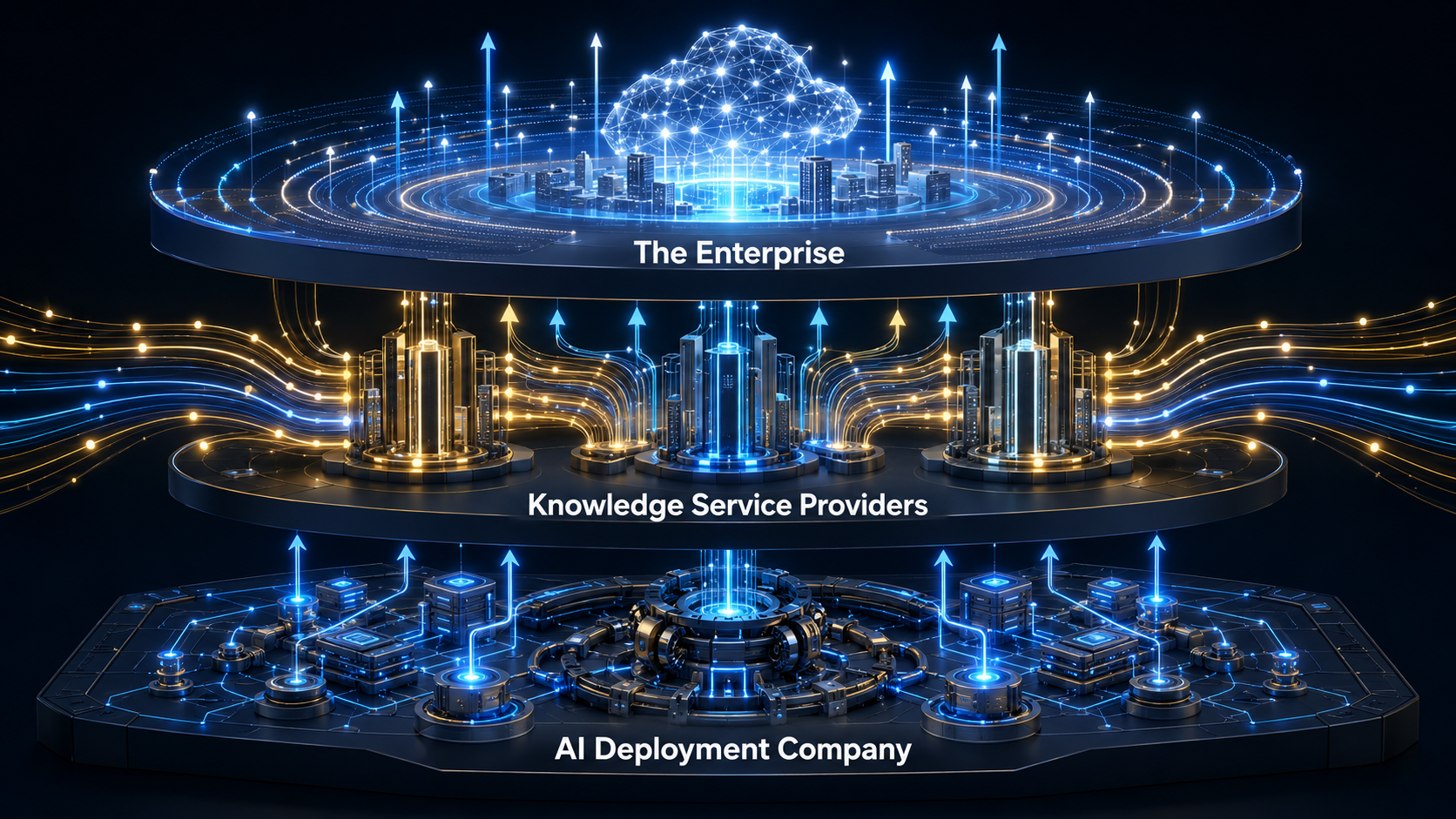
What does the AI economy supply chain look like?
The deployment company builds and maintains your internal platform, and kickstarts the flywheel.
Above it are your knowledge service providers: specialist firms gone deep in a vertical, pooling what they learn from every engagement and re-delivering that expertise continuously into their clients' agent fleets. Not renting agents, but delivering continuously compounded knowledge. Think of it like a great paid newsletter like Stratechery or The Exponential View: an expert going very deep on a specific beat, synthesising intelligence from across a wide network, re-delivering it scalably to subscribers. But the delivery mechanism here is agent-to-agent, not email.
At the top is the enterprise's own context. The starting point is delivered by the knowledge service providers, and then internally refined with the company's own culture, adaptations, strategic instincts, institutional memory. That layer belongs to no one else. That is what AI sovereignty, properly understood, actually means.
When you gaze into an LLM, the LLM gazes back at you
The 4 new AI deployment companies exist to deploy the services of OpenAI, Anthropic, Microsoft and Amazon. Every one of them has a material interest in getting you operationally locked in, with your data and workflows on their platforms. They happen to be all US-headquartered, and operating within a US policy framework. Several have an explicit incentive to learn from your usage to train their own models or inform their own product expansion strategy.
As a clever VC friend once memorably commented:
"a company is just a bunch of workflows and a bank account"
If you hand over all your workflows, you might quickly discover that all you've been transformed into is an AI reseller.
In Tolkien's Lord of the Rings, the palantír were powerful and irresistible seeing-stones. But they were a two-way street: when you looked into one you would find Sauron looking back. Every prompt you send to a hosted AI model is a kind of palantír moment: you're not the only one doing the seeing.
Isn't it curious that Peter Thiel named his company after that? I suspect the irony doesn't escape Palantir's CEO Alex Karp, who bluntly declared that US enterprise CEOs are "livid" at the major AI labs and are saying:
"I am paying for tokens that create no value. These people are stealing the weights and alpha of my business."
Satya Nadella has called this the reverse information paradox: you pay for intelligence twice. Once with money, and again with the proprietary knowledge you must reveal to make it useful. Every correction, every workflow trace, every eval: distilled institutional know-how leaking almost imperceptibly into someone else's model. As Chamath Palihapitiya observed on the All In podcast, this is the cloud model itself under pressure:
"The industry spent all these years convincing everyone to flip to the cloud, and this idea of shared infrastructure may not be the best idea in a world of [artificial] intelligence."
If your AI vendor is also selling intelligence to your competitors (and they all are) your interests are not fully aligned. You might be expensively funding your own commoditization. What every company needs is an AI-native transformation partner who is not primarily in the business of selling tokens or cloud.
Enter the sovereign AI deployment company
Truly AI-native. Not aspirationally. It runs on its own fleet of agents. Its own operations compound on the same principles it is selling to clients. It doesn't send humans to do an AI's job. It scales delivery exponentially while scaling headcount linearly.
Structurally sovereign. Not "we comply with GDPR." Not "we have a European data centre." The architecture is designed so that your data, your workflows, your context (your alpha) never leaves your estate. They don't want or need your data, they only want your repeat business.
Indifferent to your cloud. On-prem/private-cloud by default. Multi-cloud without allegiance.
Full-service. Large enough to be credible to a board that needs to choose full-service partners in 2026. Engineering depth. Strategic guidance. Workforce training. Reference clients and established partnerships.
That combination doesn't currently exist as a single company. Mistral and Germany's Aleph Alpha have built credible sovereign model infrastructure, but they aren't deployment companies. The traditional integrators are still doing RPA. The boutique integrators have sovereignty ambitions but don't have the platform. The new AI deployment companies have scale but not sovereignty. Nobody has put all together yet.
Why AI-native matters
The AI-native deployment company has three new characteristics you won't find in a pre-AI company: 1. Machine Speed: a deployment company running on its own agent fleet can iterate and improve continuously, not quarterly. 1. Scaling: its value generation isn't limited by the number of people it can hire, train and retain. 1. Longevity: it has zero turnover of intellectual capital.
This competes with Accenture the way Accenture competed with the typing pool.
What this is worth
The most visible data point on what the market pays for compounding intelligence infrastructure is Palantir, currently trading at around 60x revenue. Palantir is a legitimate outlier — defence contracts, a decade of patient capital, and a devoted retail investor following all inflate that number in ways that don't generalise. So discount it aggressively. Apply an 80% haircut to strip out those circumstances entirely. You're still at 12x revenue.
That residual isn't an accident. It reflects what investors pay for a business where the core delivery infrastructure gets better with every engagement (where accumulated context compounds into a moat that a new entrant can't buy or replicate). PwC's deals practice described it plainly in 2025: the companies commanding premium exits are those "building data moats that compound over time," specifically those generating "proprietary context that makes AI better over time in ways competitors can't easily replicate."
An AI-native deployment company whose agent fleet is the delivery layer (and whose agents accumulate client context, workflow knowledge, and domain expertise with every engagement) is not priced as a services business. It is priced as infrastructure. The 12x floor, even after every Palantir-specific discount has been applied, is the market telling you something about what that distinction is worth.
What we're building
Over the last four months we have personally witnessed what happens when employees work alongside agents in a compounding context layer. Trust builds. Work that would have taken weeks happens in hours. The flywheel spins. We see the same pattern in every company that's genuinely winning with AI.
At Jentic, we've been building toward this since 2025: agents, then an internal fleet, now the multiplayer context layer that puts compounding intelligence in the hands of every employee. We're now partnering with specialist service providers and integrators to deliver this at enterprise scale, and identifying open-core technology partners to build the sovereign agent OS this market needs.
If you're thinking about this as a potential client, partner, or someone who wants to back this bet, drop me an email (sean at jentic dot com).